





Introduction
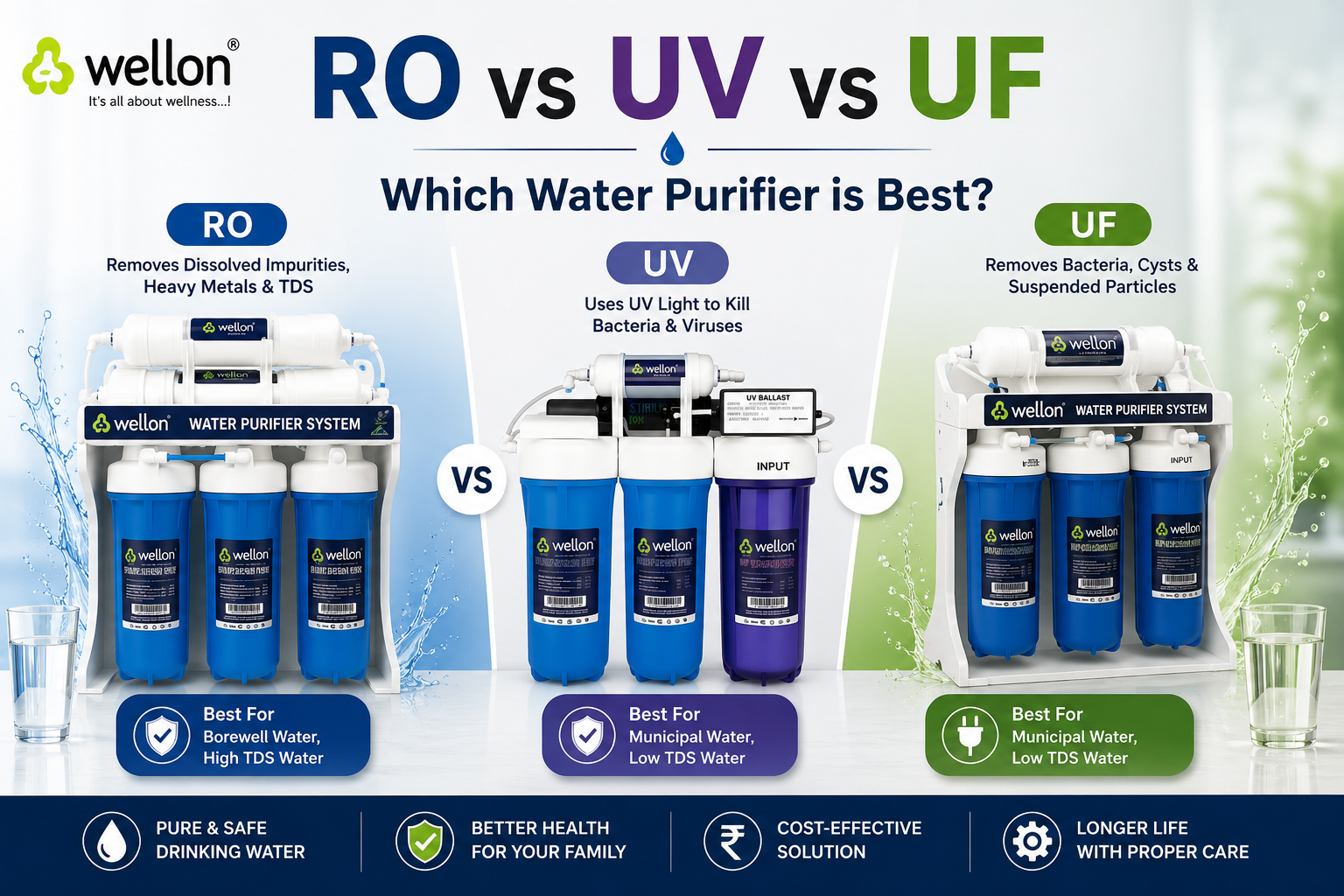
Choosing the right water purifier is essential for safe drinking water. RO, UV, and UF technologies are designed for different water conditions. Understanding their differences helps you select the best purifier for your home.
1. Reverse Osmosis (RO)
RO uses a semi-permeable membrane to remove dissolved salts, heavy metals, fluoride, arsenic, and other impurities.
Best For:
- Borewell Water
- Tanker Water
- High TDS Water
2. Ultraviolet (UV)
UV technology uses ultraviolet light to deactivate bacteria and viruses without changing the mineral content of water.
Best For:
- Municipal Water
- Low TDS Water
- Microbiologically unsafe water
3. Ultrafiltration (UF)
UF uses a hollow fiber membrane to remove suspended particles, bacteria, and cysts. It does not reduce dissolved salts and works without electricity.
Best For:
- Municipal Water
- Low TDS Water
- Areas with stable water quality
Quick Comparison
| Feature | RO | UV | UF |
|---|---|---|---|
| Removes TDS | ✅ | ❌ | ❌ |
| Removes Heavy Metals | ✅ | ❌ | ❌ |
| Removes Bacteria | ✅ | ✅ | ✅ |
| Removes Viruses | ✅ | ✅ | Limited |
| Electricity Required | ✅ | ✅ | ❌ |
Which One Should You Choose?
- RO – Ideal for borewell, tanker, or high TDS water.
- UV – Suitable for municipal water with low TDS but possible microbial contamination.
- UF – Best for low TDS municipal water where electricity-free purification is preferred.
Many modern water purifiers combine RO + UV + UF technologies to provide comprehensive purification and improved water quality.
Conclusion
There is no single water purifier that suits every home. The right choice depends on your water source, TDS level, and overall water quality. Testing your water before purchasing ensures you select the most suitable purification technology for safe and healthy drinking water.